Exterior Painting Colorado Springs: The Process Behind a Lasting Coat
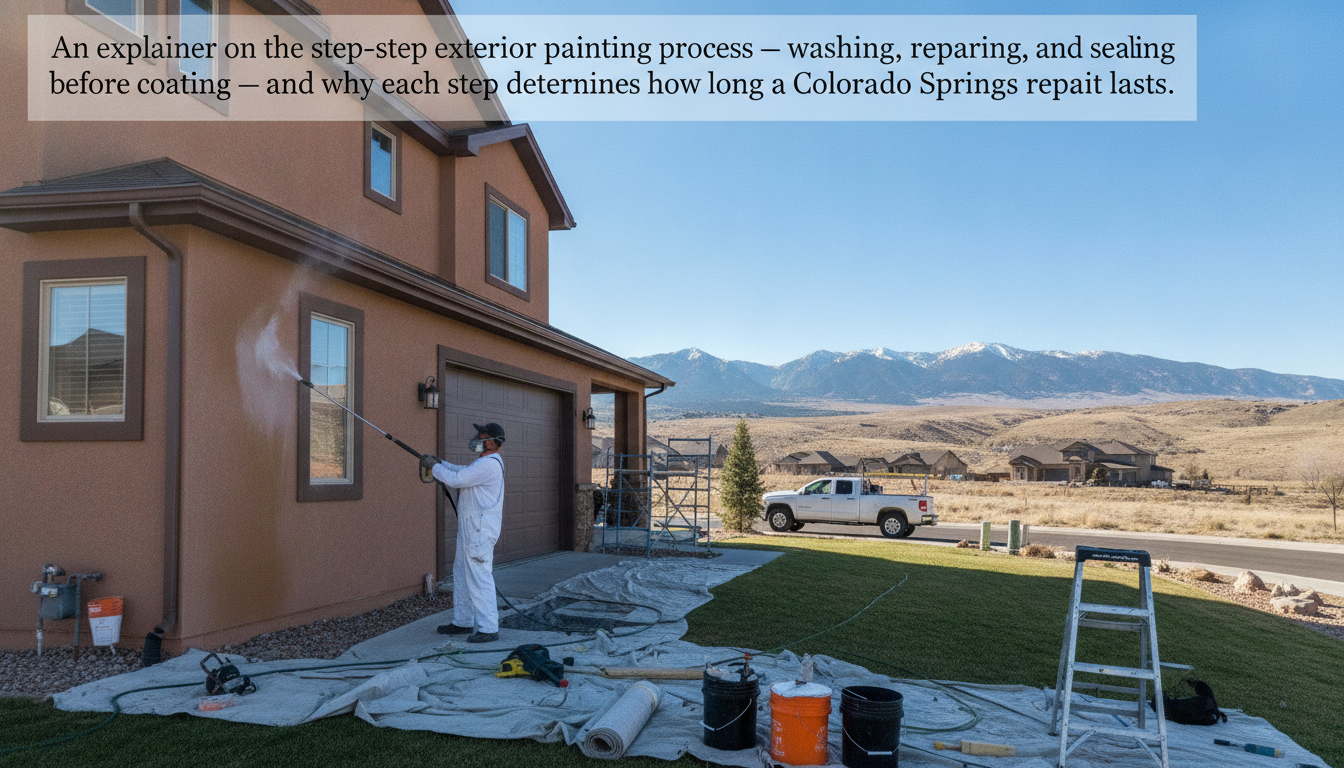
How exterior painting in Colorado Springs really works — wash, repair, seal, then coat. Why the order matters as fall closes out the season.
Early fall along the Front Range is decision time for exterior painting. The days are still warm enough, the nights are starting to bite, and homeowners are trying to figure out whether there's a window left before winter — or whether it makes more sense to wait for spring. Either way, it helps to understand what actually happens during an exterior repaint, because the process is what decides whether the job lasts five years or ten.
Why the Order of Operations Matters
A lot of homeowners assume exterior painting is mostly about the coating itself — which product, how many coats. In practice, the steps before the paint ever comes out of the can are what determine whether that coating holds. Skip one, and you're not saving time. You're buying a repaint sooner than you should have.
1. Wash the House Down First
Nothing gets prepped and nothing gets coated until the house has been washed. Front Range exteriors collect chalked paint residue, plains dust, pollen and mildew on the shaded, north-facing side. Paint does not bond to any of that. It bonds to a clean, sound surface — and washing is the step that makes the rest of the process possible.
2. Repair What Has Failed
Split trim, soft siding, cracked stucco, rot behind a downspout — coating over a substrate that's already gone doesn't fix it. It hides it for a season, and then it costs a whole job to put right, on top of what you just spent. This is where composite hardboard siding on homes built between the late 1970s and the 1990s tends to show up: the cut bottom edge wicks up water, the board swells, and the layers start to separate. It's usually one or two elevations rather than the whole house, but it needs to be caught before paint goes anywhere near it.
3. Seal the Openings
Nail heads, board seams, joints, gaps around penetrations — this is the step most often skipped, and it's the one that stops a cosmetic paint job from turning into a rot problem two years down the line. Sealing is what keeps water from finding its way behind the coating in the first place.
4, 5, 6. Scrape, Prime, Coat
Only after washing, repairing and sealing does the surface get scraped and sanded back where anything is loose, feathering the edges so repairs don't telegraph through the finish. Bare substrate, repairs and anything likely to bleed through get spot-primed — bonding, stain-blocking or sealing primer, chosen for the specific problem, not just a cheaper first coat. Then it's coated, specified per surface and per elevation.
Why Elevation and Altitude Change the Spec
At 6,000-plus feet, the UV load is materially higher than at sea level, and south and west walls take the brunt of it. Those elevations chalk and fade years before north and east walls on the same house. That's why the coating spec should change by wall, not just by house — a one-size approach leaves the hardest-working sides under-protected.
100% acrylic coatings are the standard choice on siding and trim here because they stay flexible through Colorado's 30-to-40-degree daily temperature swing. A brittle coating cracks right at the joints that are supposed to be keeping water out. Cheaper vinyl-acrylic blends chalk and fade noticeably sooner on a sunny wall. On stucco, block or concrete, a masonry or elastomeric coating can bridge hairline cracking and shed water — but only where the wall calls for it. A high-build coating also slows outward drying, and on a wall that already holds moisture, that can make things worse. That's a judgment call made on site, not a default answer.
Why the Season Has a Hard Stop
Exterior coatings need the surface above roughly 50°F for the entire cure, not just at the moment of application. A warm October afternoon followed by a freezing night ruins a coat that looked perfect at five o'clock. That's why exterior work here generally runs April through October, with late spring and early fall the sweet spot — and why afternoon thunderstorms through July and August set a daily cutoff of their own, since wind off the plains drifts spray and puts grit in a wet film.
Repaint Cycles and Hail
Most homes in the region are due for a repaint every 5 to 10 years, though the real test is the wall, not the calendar — if the sunniest elevation leaves powder on your hand, the coating is chalking and won't hold a new coat until it's washed clean. El Paso County is also one of the more hail-prone corridors in the country, and hail damage to siding or trim often doesn't show up until the following season, which is one more reason a proper inspection matters before repainting over it.
One Contractor for the Paint and the Repair
Happy Painting Inc. has been serving Colorado Springs for 13 years, and owner Josh Welp has more than 25 years in the painting trade — as a painter, then years on the supply side specifying coatings for other contractors, now running his own crews. He handles the estimating and project management himself, and he checks in while a project runs and again after it's finished to confirm the work is holding. Painting and the repairs underneath it — drywall, stucco, siding and trim — are handled in the same scope, which matters most on exteriors, where a failed substrate is the usual reason a repaint doesn't last.
Happy Painting serves Colorado Springs and roughly 50 miles around it, including Monument, Castle Rock, Black Forest, Falcon, Fountain, Woodland Park and Pueblo. Estimates are free, on site, and come with no obligation — worth doing now, before the fall window closes.
Frequently Asked Questions
How do I know if my house still has time for an exterior repaint this fall?
It comes down to the overnight low more than the daytime high, since most exterior coatings need the surface above about 50°F for the entire cure. A free on-site estimate is the fastest way to find out whether your project still fits the window or whether spring makes more sense.
My stucco has some cracks — does it need repair before painting?
It depends on the crack. Fine hairline crazing is normal and a good coating closes it up. A crack you can fit a fingernail into is a water path, and a patch that sounds hollow when tapped means the stucco has lost its bond — neither of those gets fixed by paint alone.
Why does my siding look fine in spring but fail by fall?
Composite hardboard siding, common on homes built between the late 1970s and the 1990s, often wicks water up through the cut bottom edge over a season, swelling and separating before it's visibly obvious. It usually shows up on one or two elevations rather than the whole house, and catching it early keeps the repair small.